Something is stirring in Busan!
By most conventional measures, this should be a story about decline. In April 2026, a Seoul court declared Amazing Brewing Company — once a poster child of Korea's craft beer boom, a brewery that had floated IPO ambitions as recently as 2021 — bankrupt. Three months earlier, Y Brewery, operator of the Bronx franchise, filed for bankruptcy protection. Sevenbrau, one of the country's first-generation craft brewers, posted losses of roughly $12 million in 2024 alone. Craft beer's share of the Korean market slid from 2 percent in 2022 to just over 1.3 percent, and the country's overall alcohol consumption keeps shrinking as younger Koreans drink less.
But walk into a taproom in Seomyeon or Songjeong on a Friday night, and decline is not the word that comes to mind. Something is stirring in Busan — and it looks less like a market correction than an awakening.
The Boom That Outran Its Roots
Korean craft beer has been around long enough to have a history. The deregulation of 2011 lowered the minimum production capacity for a brewing license from one million liters to 150,000, cracking open a door that had been welded shut for decades. A further reduction to 50,000 liters in 2014 blew it off its hinges, and breweries multiplied — over 180 microbreweries at the peak, by the Korean Craft Brewers Association's count. Pandemic-era rule changes allowing craft beer into convenience stores sent sales up nearly 500 percent in a single year.
And then, as happened almost everywhere in the world, the retraction came. Korea's drinking culture is entirely its own — a table where beer is inseparable from food, company, and the rhythm of the night out — and it has never needed to imitate anyone. But the contraction did expose a structural difference between Korea's boom and the scenes that weathered the same storm elsewhere in Asia: Korean craft grew up fast inside a retail system that rewarded scale and shelf price over depth. When the money left, that difference mattered.
As Korea's own industry press has chronicled, convenience-store economics pushed many brewers toward shelf price instead of flavor — higher adjunct ratios, pasteurization for shelf life — trimming away the very qualities that justified the word "craft" on the label. The breweries that scaled fastest were the ones squeezed hardest. When demand softened, they were left holding expanded production capacity, high fixed costs, and beer that no longer gave anyone a reason to pay a premium.
The Center of Gravity Moves South
Which brings us to Busan. Korea's second city has quietly become what beer enthusiasts now call the country's craft mecca — a status the city government has formalized by designating craft beer one of Busan's signature tourism products. The Busan Craft Beer Festival is in its ninth year; the Centum Beer Festival ran ten days at the Busan Cinema Center this past May; the Craft Beer Masters Challenge, launched in 2018, has grown into a national platform.
But festivals are the visible surface. The more consequential story is a small circle of brewers who have decided that the way forward is not the scale-first, shelf-driven model of the boom years, but the collaborative, open-source ethos that built craft beer's strongest scenes in the United States, Australia, New Zealand, and Japan.
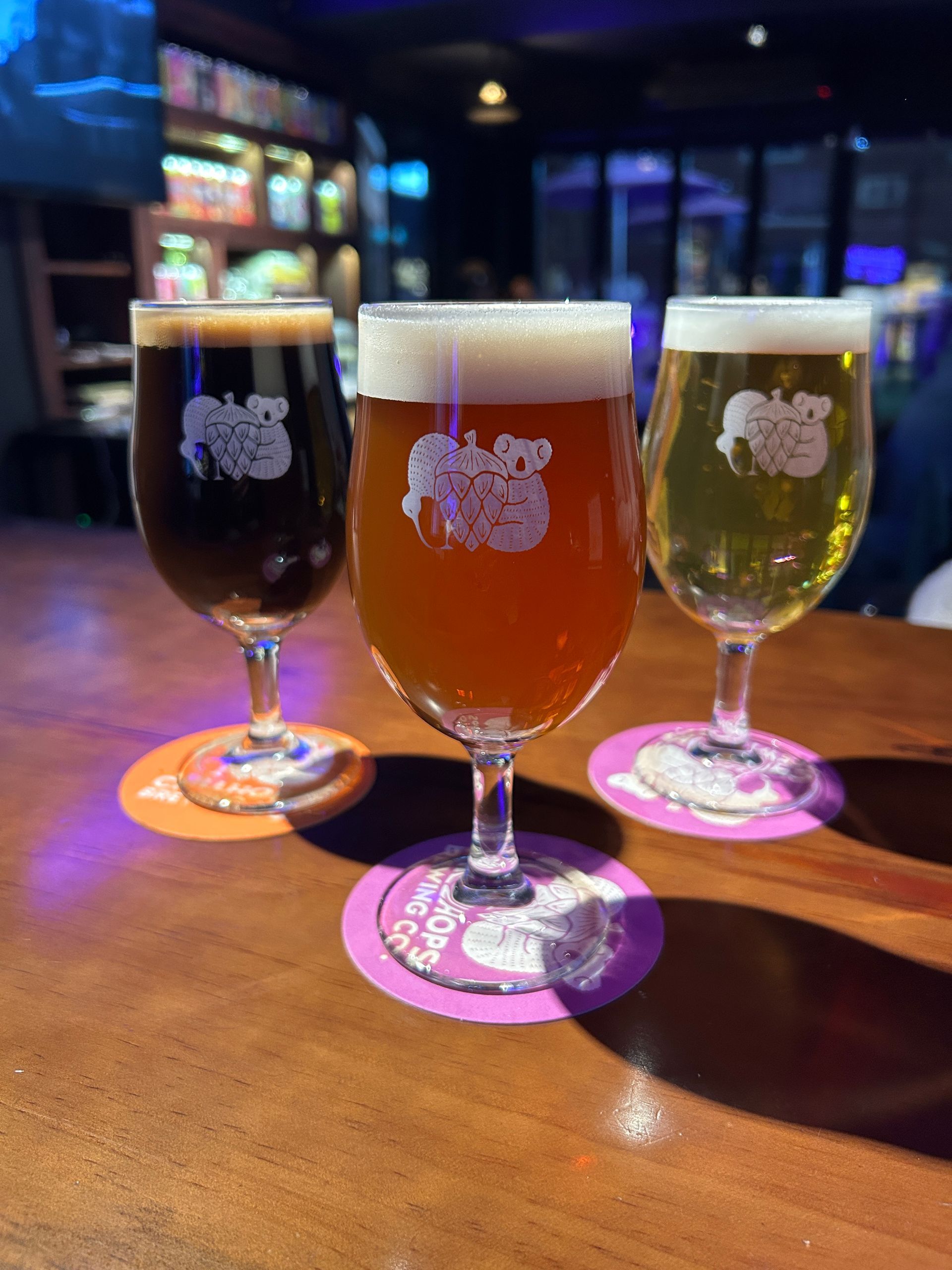
At the front of that circle is Wildcat Brewing, whose Seomyeon taproom looks directly over its own brewing vats. Founded by a Korean-American craft beer devotee but Busan to the bone in its brewing, its staff, and its regulars, Wildcat fuses West Coast hop-forward tradition with local Korean ingredients: a Cold IPA here, a beer-tea lager there, sours that don't apologize for themselves. Around it orbits a coalition that could only have assembled in this city. Gorilla Brewing, the stalwart that helped put Busan on the map as one of Korea's first craft exporters, has made collaboration something close to a house style — its Godfather barrel-aged sour, brewed jointly with fellow Busan breweries Galmegi and Daedo and aged 26 months in oak, is the kind of project no Korean brewery would have attempted alone a decade ago. Out along the coast in Songjeong, Turmbräu — whose owner-brewer carries a family brewing tradition dating to 17th-century Mühldorf am Inn — brews Reinheitsgebot discipline within earshot of the surf. And the circle extends well beyond the brewhouses: dedicated homebrewers and a devoted cast of craft beer barflies, regulars of the taproom crawl from Seomyeon to Gwangalli, whose hunger for the best beer that can be made keeps the brewers honest.
Why Collaboration Is the Whole Point
It would be easy to read collaboration beers as marketing — two logos on a can, a limited release, a bump on Untappd. That misses what is actually being exchanged. When brewers work in each other's brewhouses, techniques migrate: a German lagering regimen shows up under an American hop bill; a sour program's mixed cultures find their way into a brewery that had never touched one. Each collaboration leaves both breweries smarter about process and — just as important — smarter about their drinkers. A brewery that regularly opens its doors to peers gets an unfiltered read on what the market actually wants, rather than guessing from sales data alone.
This is precisely the mechanism that powered craft beer's golden ages elsewhere. The American scene was built on brewers sharing recipes, yeast, and mistakes with the people who were nominally their competitors. Japan's craft renaissance accelerated when its brewers started collaborating internationally instead of perfecting in isolation. The Busan group is not importing a style; it is building a culture — the conviction that the scene rises together or not at all.
None of this is a rebellion against anyone in particular. It is simply a different model: one that trades the boom era's centralized, shelf-driven playbook for a circuit of collaborations, festivals, and cross-pollination, and lets the results speak from the tap.
An Awakening, Not a Recovery
Korea's craft beer market will likely stay smaller than it was at the peak. That may be no bad thing. What is emerging in Busan is not a recovery of the boom but something sturdier: depth. A scene where brewers with Bavarian, American, British, and Korean roots trade techniques over a shared mash tun is a scene with roots of its own — the kind that survive winters.